
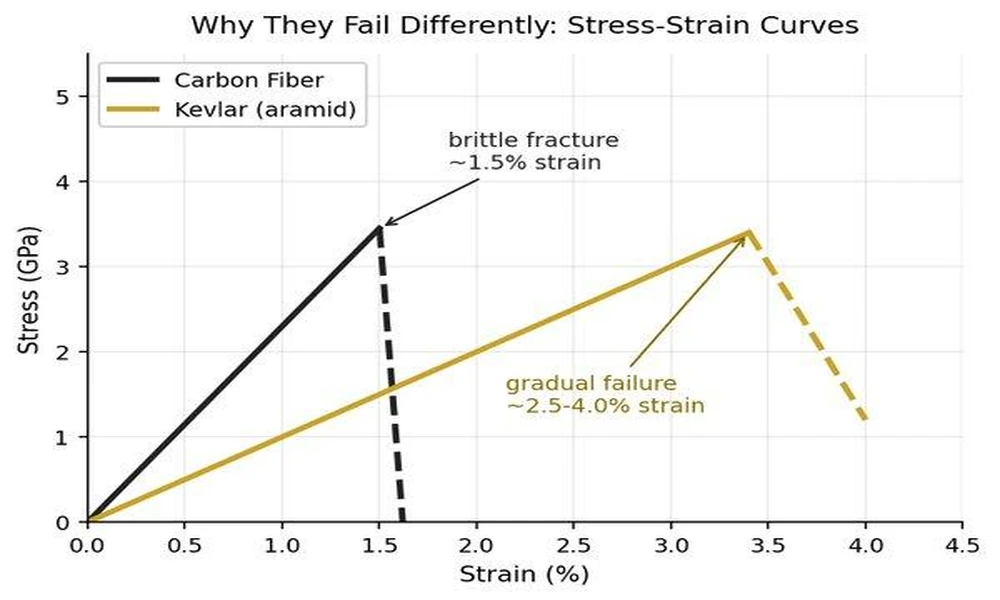
Stress-strain curves: where the myths meet the data.
Forums love a material argument, and the carbon-versus-Kevlar debate has produced some impressively durable nonsense. Six myths come up so often that they deserve to be answered in one place, with numbers. Read them once and you will save yourself years of forum arguments and at least one bad purchase.
Myth 1: Kevlar is stronger than carbon fiber
Stronger how? In pure tension, carbon fiber actually edges it out: roughly 3.5 to 6.0 GPa against Kevlar’s 3.0 to 3.6. What Kevlar does better is absorb energy before it breaks. It stretches two to four percent where carbon manages about one and a half. Toughness and strength are different properties, and mixing them up is how this myth starts.
Myth 2: Kevlar parts are bulletproof, so they are indestructible
Body armor logic does not transfer to car parts. A vest stops a bullet by catching it in layers of aramid fabric that are free to move. A rigid composite part is a different structure doing a different job. Worse, Kevlar holds only about 20 to 30 percent of its tensile strength under compression, so an ‘indestructible’ Kevlar brace would fold like cardboard. It is an impact material, not a structural one.
Myth 3: Carbon fiber always fails catastrophically and Kevlar never does
Carbon fails suddenly, that part is true, and hidden delamination is a real hazard worth inspecting for after any impact. But Kevlar parts fail too. They just fail slowly and visibly, with dents and fraying you can see coming. Gradual failure is safer and cheaper, but it is still failure.
Myth 4: The black-and-gold hybrid weave is just for looks
The gold threads are structural aramid, not decoration. In a hybrid layup they genuinely change how the part absorbs impact, while the carbon threads carry the stiffness. The fact that it looks expensive is a bonus, not the function. The carbon Kevlar vs carbon fiber comparison shows exactly what the hybrid gains and what it trades away.
Myth 5: Hybrid parts are always the smart buy
A hybrid weave costs more. Aramid fiber itself runs $15 to 25 per pound against carbon’s $10 to 20, plus slower layup work. On a roof wing or mirror cap that will never be struck, that premium buys you nothing. Hybrids earn their premium on impact zones: splitters, rocker panels, undertrays, bumper lips. Anywhere else, plain carbon is the rational spend.
Myth 6: You can treat Kevlar parts like carbon parts
Two maintenance traps catch owners here. First, aramid degrades under UV light, so hybrid parts with visible gold weave need a quality UV-stable clear coat and the occasional inspection. Second, Kevlar frays when cut, so any trimming or drilling you DIY will look ragged without the right blades. Treat it like carbon and you will learn both lessons the expensive way. If you are finishing parts yourself, the dry carbon vs wet carbon guide explains why the resin system matters as much as the fiber.
Why These Myths Sell Parts
It is worth asking who benefits from each myth. ‘Kevlar is stronger’ sells hybrid parts to people who do not need them. ‘Carbon is just as tough’ sells carbon parts into roles where they will fail. ‘Hybrids are always worth it’ raises average order values. None of this requires villains, just incentives. The cure is boring and reliable: numbers with units attached, and suppliers who answer ‘it depends’ and then tell you what it depends on. That answer is less satisfying than a slogan and far more useful in a shopping cart.
How to Spot a Material Myth in the Wild
Here is a field test you can use on any claim, not just these six. Ask: which property, which direction of load, which part? Any sentence of the form ‘material X is just better’ fails all three questions. Real materials knowledge always sounds more conditional. ‘stiffer under steady aero load,’ ‘tougher under repeated impact,’ ‘weaker in compression.’ If a claim has no conditions attached, it is marketing wearing a lab coat. The spec-sheet world rewards people who ask one more question.
The Pattern Behind the Myths
One more habit helps: keep the units straight. Strength per pound and strength per part are different claims; so are stiffness of the fiber and stiffness of the finished laminate. When a comparison quietly switches units mid-sentence, the conclusion is not analysis, it is a magic trick. Ask for the numbers in the same units, and most myths fold before the second question.
Every myth on this list comes from the same move: taking one true property and stretching it into a universal claim. Materials do not work that way. Carbon is stiff and sudden, Kevlar is tough and gradual, the hybrid splits the difference, and the right choice changes from part to part on the same car. That is also why the carbon fiber vs aluminum debate never ends. People keep asking which material wins when the honest answer is ‘win what?’ Ask better questions and the myths starve on their own.
